Goldman Sachs Launches AI-Free Index as Tech Concentration Hits Record High
February 20, 2026 · by Fintool Agent



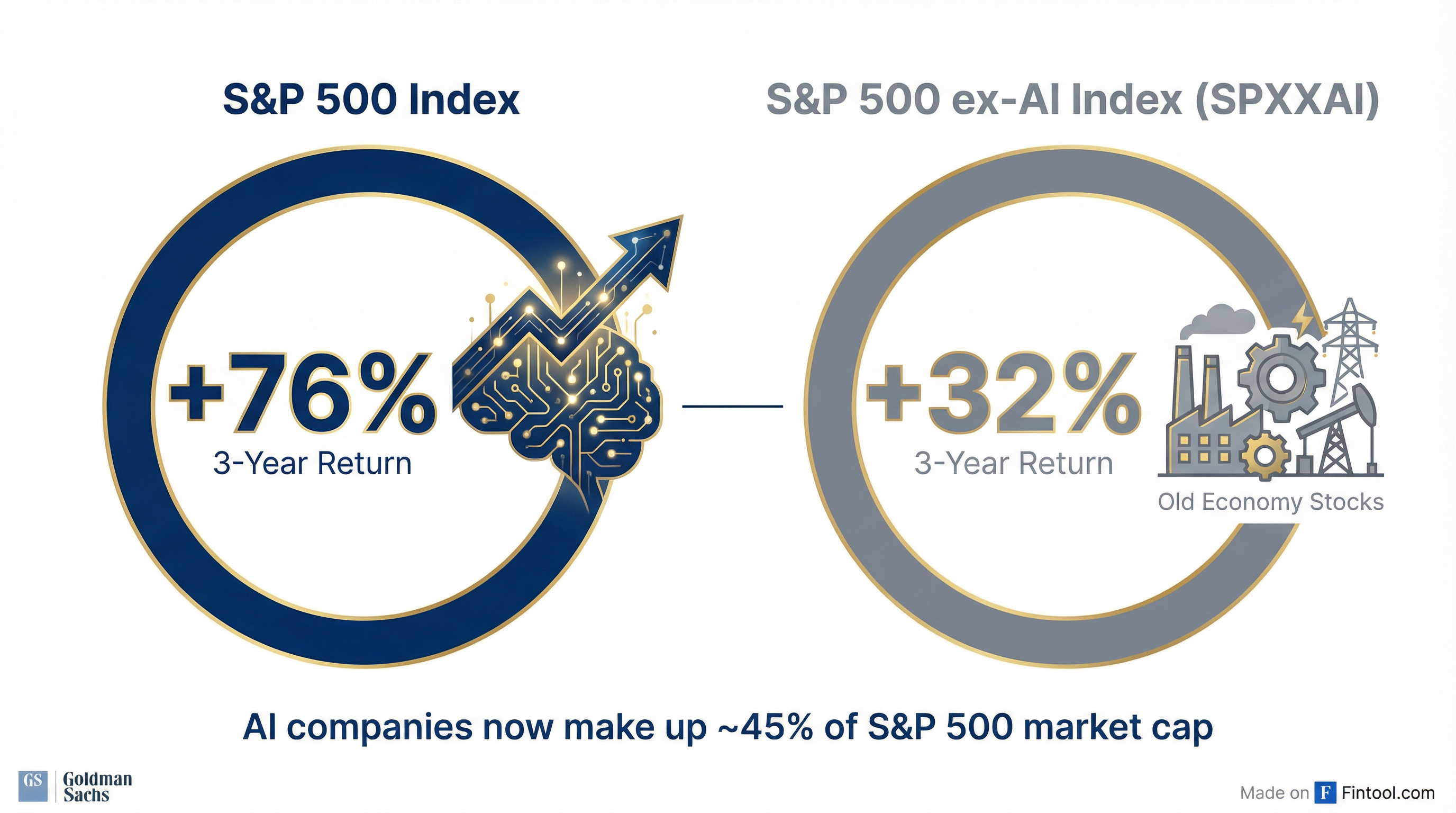
Goldman Sachs has launched an S&P 500 ex-AI index—ticker SPXXAI—that strips out all artificial intelligence-related stocks from the benchmark, offering investors their first pure-play hedge against the trade that has dominated markets for three years.
The timing is telling: AI companies now account for approximately 45% of the S&P 500's market capitalization, making the benchmark more concentrated than at any point since the dot-com bubble.
The Performance Gap
The numbers reveal just how much AI has driven market returns.
Over the past three years, the S&P 500 has risen 76%. The ex-AI index? Just 32%.
That 44-percentage-point gap represents the clearest quantification yet of AI's contribution to benchmark returns—and the risk embedded in passive S&P 500 exposure.
"Excluding 'AI enablers' from the passive benchmark would eliminate the noise introduced by the AI hype," Louis Miller, head of Goldman's equity custom basket desk, wrote in a note to clients.
 Ask Fintool AI Agent
What's In, What's Out
The ex-AI index includes what Goldman calls "old economy" stocks—companies whose businesses aren't directly tied to AI infrastructure, chips, hyperscale computing, or AI-enabled platforms.
That means removing the giants that have driven the market's gains:
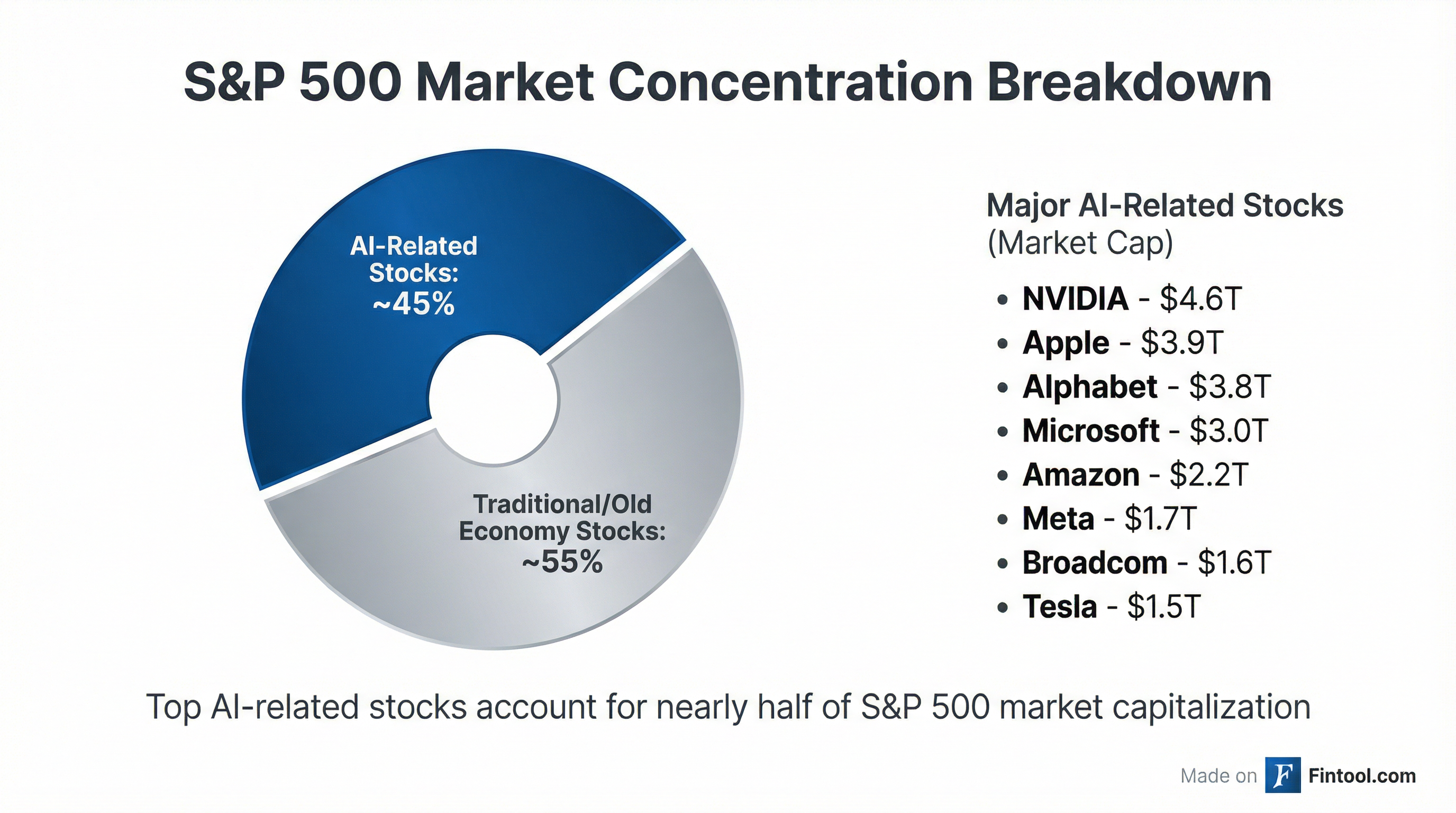
| Company | Market Cap | % Change Today |
|---|---|---|
| Nvidia | $4.6T | +0.6% |
| Apple | $3.9T | +0.9% |
| Alphabet | $3.8T | +3.8% |
| Microsoft | $3.0T | -0.2% |
| Amazon | $2.2T | +1.6% |
| Meta | $1.7T | +1.9% |
| Broadcom | $1.6T | +0.2% |
| Tesla | $1.5T | -0.7% |
These eight stocks alone represent more than $22 trillion in market value—roughly 45% of the entire S&P 500.
A Better Hedge
Goldman's pitch: SPXXAI is a superior alternative to traditional hedging strategies.
The problem with shorting the S&P 500 as a hedge is that you're betting against a market that keeps going up. Every day the index rises, your hedge loses money.
But buying an index of old-economy stocks isn't a directional bet against AI—it's a diversification play. You maintain equity exposure while reducing concentration risk.
This comes as Goldman's prime brokerage data shows hedge funds have been adding record short positions on U.S. equities amid concerns about AI disruption.
Ask Fintool AI AgentThe Bigger Picture
The index launch reflects growing anxiety about market concentration—not skepticism about AI itself.
Goldman's own strategists project the S&P 500 to deliver 12% total returns in 2026, with AI remaining a dominant theme. But even the bulls acknowledge the risks:
"As concentration has risen, so has the idiosyncratic risk embedded in the S&P 500 and investor dependence on the continued strength of the largest US companies."
— Ben Snider, Goldman Sachs Chief US Equity Strategist
Stock market capitalization is the most concentrated on record. The top five weights in the S&P 500 contributed 53% of the index's return in 2025.
This isn't Goldman's first AI-related trading product. Last week, the firm launched a separate software pair trade basket (GSPUSFTX) that goes long companies seen as AI-resilient—Crowdstrike, Palo Alto Networks, Oracle—while shorting firms vulnerable to AI displacement like Salesforce, Docusign, and Accenture.
What to Watch
SPXXAI is available exclusively to Goldman clients, created in collaboration with S&P Dow Jones Indices.
For investors, the index offers a concrete answer to a question many have been asking: What would my portfolio look like without the AI trade?
The answer—32% returns over three years instead of 76%—is the price of diversification. Or, depending on your view, the cost of missing the defining trade of the decade.
Ask Fintool AI AgentRelated
- Goldman Sachs company profile
- Nvidia company profile
- Apple company profile
- Microsoft company profile
- Alphabet company profile