Earnings summaries and quarterly performance for TYSON FOODS.
Research analysts who have asked questions during TYSON FOODS earnings calls.

Andrew Strelzik
BMO Capital Markets
7 questions for TSN

Alexia Howard
AllianceBernstein
6 questions for TSN
Heather Jones
Heather Jones Research
6 questions for TSN
Michael Lavery
Piper Sandler & Co.
6 questions for TSN

Peter Galbo
Bank of America
6 questions for TSN
Pooran Sharma
Stephens Inc.
6 questions for TSN
Benjamin Theurer
Barclays Corporate & Investment Bank
5 questions for TSN
Leah Jordan
Goldman Sachs Group, Inc.
4 questions for TSN
Thomas Palmer
Citigroup Inc.
3 questions for TSN
Tom Palmer
JPMorgan Chase & Co.
3 questions for TSN
Ben Theurer
Barclays
2 questions for TSN
Kenneth Goldman
JPMorgan Chase & Co.
2 questions for TSN
Manav Gupta
UBS Group
2 questions for TSN
Saumya Jain
UBS
2 questions for TSN
Guilherme Palhares
Santander
1 question for TSN

Puran Sharma
Stevens Inc.
1 question for TSN
Samaya Jain
UBS
1 question for TSN
Recent press releases and 8-K filings for TSN.
- All 16 directors re-elected, ratification of PricewaterhouseCoopers LLP as auditor, amendment of the Stock Incentive Plan, and advisory approval of executive compensation by clear majorities
- Three shareholder proposals—class vote disclosure, environmental impacts from waste lagoons, and immigration impact report—were defeated, each receiving minority support
- FY 2025 sales of $54.4 billion (+2.1%), $2.2 billion in operating cash flow, and net leverage of 2.1×; board increased the FY 2026 dividend to $2.04 per Class A share, marking the 14th consecutive annual increase
- CEO Donnie King highlighted strong protein demand, leadership across three top-10 brands, and commitment to operational discipline and financial strength to drive future growth
- At the 63rd annual meeting, shareholders re-elected the full slate of directors, ratified PricewaterhouseCoopers as auditor, approved an amended stock incentive plan, and passed the advisory say-on-pay resolution by clear majority.
- Proposals on disclosing vote results by share class, reporting environmental/human health impacts of waste lagoons, and assessing immigration practice impacts all failed to gain majority support.
- CFO Curt Calaway reported FY 2025 sales of $54.4 billion (+2.1%), operating cash flow of $2.2 billion, net leverage improved to 2.1×, and total shareholder returns of $893 million, including an increased annual dividend of $2.04 per share.
- CEO Donnie King reaffirmed Tyson’s leadership in the U.S. protein market—producing one in five pounds of chicken, beef, and pork—and underscored focus on affordable, nutritious, branded products and disciplined capital management.
- Shareholders elected the full slate of directors and ratified PricewaterhouseCoopers LLP as independent auditor for FY 2026.
- Shareholders approved the amendment to the Tyson Foods stock incentive plan and the non-binding advisory vote on executive compensation.
- Three shareholder proposals—to disclose voting results by share class, to report on environmental and human health impacts of waste lagoons, and to assess immigration policy changes—were each defeated by majority votes.
- CFO reported fiscal 2025 sales of $54.4 billion (+2.1%), operating cash flow of $2.2 billion, net leverage of 2.1×, and announced a 14th consecutive dividend increase to $2.04 per share for FY 2026, returning $893 million through dividends and share repurchases.
- CEO highlighted Tyson’s leadership in producing one in every five pounds of U.S. chicken, beef, and pork, the strength of top-10 brands Tyson, Jimmy Dean, and Hillshire Farm, and the company’s “feed the world like family” purpose amid growing protein demand.
- Sales increased 6.2% to $14.3 billion; Segment Operating Income was $811 million, down 12% year-over-year; Adjusted EPS of $0.97 reflected a 15% decline.
- Prepared Foods sales rose 8.1%, with Segment Operating Income of $338 million (+$16 million), while Chicken delivered $459 million in segment income (10.9% margin) and beef segment profits declined amid planned plant closures.
- Transitioned from Adjusted Operating Income to Segment Operating Income (excluding corporate expenses and amortization) for clearer performance assessment; historical results have been recast accordingly.
- Full-year guidance: Sales up 2–4%, Adjusted Operating Income of $2.1–2.3 billion, Free Cash Flow of $1.1–1.7 billion; segment outlook includes Beef losses of $500–250 million and Chicken income of $1.65–1.9 billion.
- Total company sales rose to $14.3 billion (+6.2% YoY), while Q1 segment operating income declined 12% to $811 million.
- Prepared Foods delivered $338 million in segment operating income on 8.1% sales growth, and the Chicken segment generated $459 million in operating income at a 10.9% margin.
- In Beef, Tyson closed its Lexington, NE facility and reduced Amarillo, TX operations, with segment operating income falling on elevated cattle costs; full-year Beef is forecasted to incur losses of $500 million–$250 million.
- Q1 free cash flow totaled ~$700 million (operating cash flow $942 million less $252 million in capex), ending with $4.5 billion liquidity and net leverage of 2.0×; returned $224 million to shareholders, including $47 million in buybacks.
- For FY 2026, Tyson expects sales growth of 2%–4% and adjusted operating income of $2.1 billion–$2.3 billion, with CapEx of $700 million–$1 billion and segment income guidance across all divisions.
- Sales increased by more than 6% year-over-year, driven by broad-based strength across protein segments.
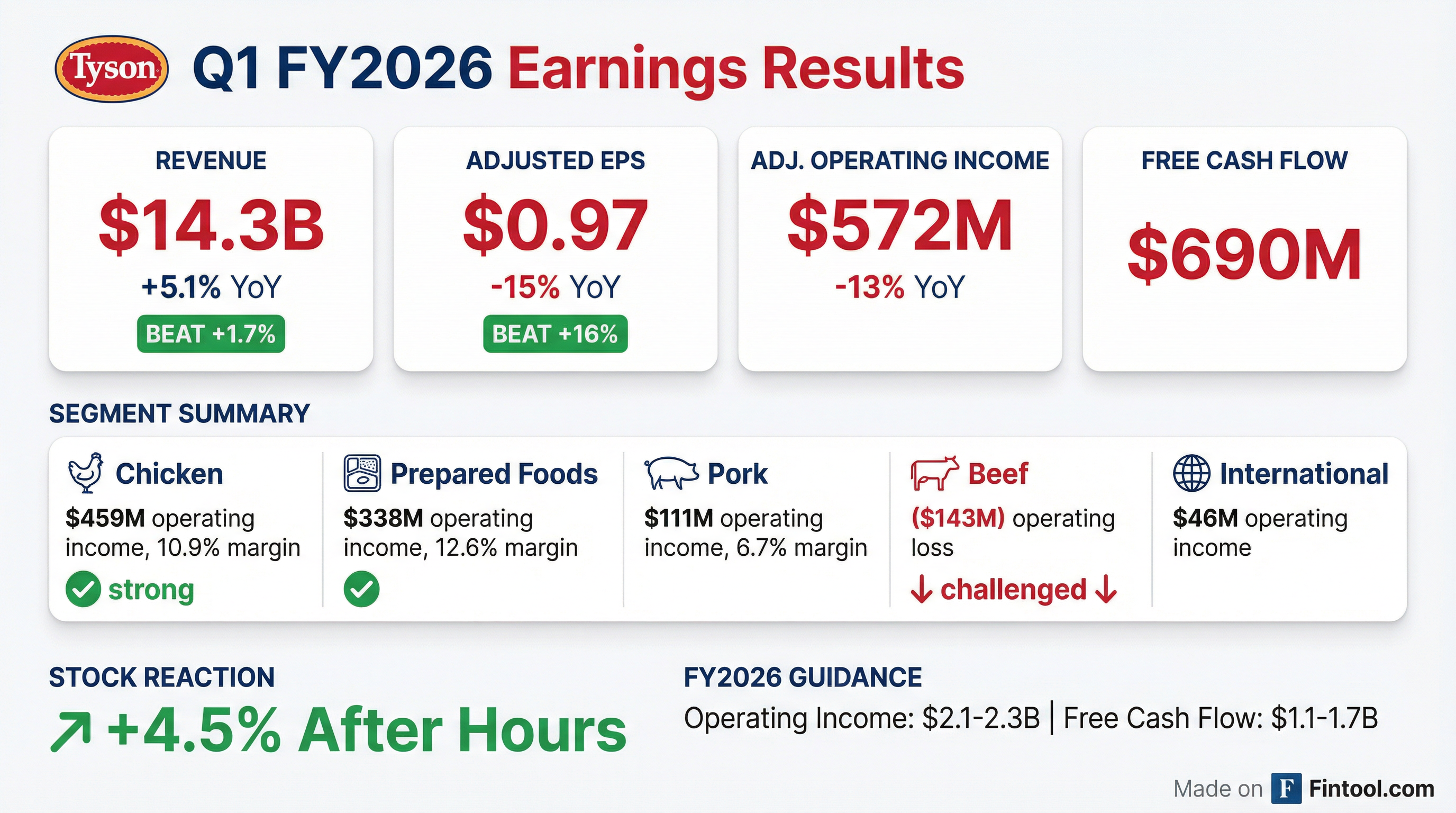
- 1Q26 Adjusted Operating Income was $572 million (4.0% margin) on $14.3 billion of sales, and Adjusted EPS was $0.97.
- Free Cash Flow totaled $690 million, while net debt to Adjusted EBITDA improved to 2.0×, reflecting strong cash generation and deleveraging.
- Returned capital via a $224 million share repurchase in the quarter.
- FY26 guidance calls for 2–4% sales growth, $2.1–2.3 billion of Adjusted Operating Income, and $1.1–1.7 billion of Free Cash Flow.
- Total company net sales grew 6.2% to $14.3 billion, and Q1 segment operating income was $811 million, down 12% YoY driven by beef segment losses.
- Prepared Foods sales increased 8.1%, with segment operating income of $338 million, up $16 million YoY; Chicken segment operating income was $459 million (10.9% margin) from volume growth and operational efficiency.
- Tyson is closing its Lexington, NE beef facility and reducing Amarillo, TX to a single shift to improve capacity utilization; beef segment income declined as higher cattle costs offset cutout values.
- Q1 operating cash flow was $942 million, CapEx $252 million, free cash flow ~$700 million; liquidity ended at $4.5 billion, net leverage 2.0×, and share repurchases totaled $47 million.
- 2026 guidance: sales up 2–4%, adjusted operating income $2.1–2.3 billion, free cash flow $1.1–1.7 billion, with segment operating income outlook including beef losses of $500–250 million and chicken at $1.65–1.9 billion.
- Effective Q1 fiscal 2026, Tyson Foods no longer allocates corporate expenses and amortization to reportable segments and will separately disclose these items; it also identified International as a new reportable segment.
- Segment operating income (loss) is now defined as operating income (loss) less corporate expenses and amortization and is the measure used by the CODM to assess segment performance and allocate resources.
- All prior period amounts for fiscal years 2025, 2024 and 2023 have been recast to reflect the new presentation of segment operating income (loss), with revised data provided in Exhibit 99.1.
- Tyson Foods reported adjusted EPS of $0.97 and revenue of $14.31 billion, topping first-quarter expectations.
- Beef sales volumes declined by ~7% on a 75-year low U.S. cattle herd, while chicken volumes rose for the fifth consecutive quarter.
- Raised fiscal 2026 adjusted operating income outlook for its chicken segment to $1.65–$1.90 billion, up from $1.25–$1.50 billion previously.
- Forecast fiscal 2026 sales growth of 2%–4% and ended the quarter with $4.5 billion in liquidity; GAAP cash from operations was $942 million and non-GAAP free cash flow was $690 million.
- Tyson Foods recorded $14.3 billion in sales, up 5.1% year-over-year (6.2% excluding $150 million legal accruals) in Q1 FY2026.
- GAAP operating income fell 48% to $302 million and GAAP EPS declined 76% to $0.24; on a non-GAAP basis, operating income was $572 million (–13%) and EPS $0.97 (–15%).
- Prepared Foods delivered top- and bottom-line growth, while Chicken achieved its fifth consecutive quarter of year-over-year volume gains.
- Liquidity remained strong at $4.5 billion, cash provided by operations was $942 million, and free cash flow totaled $690 million in the quarter.
- For FY2026, Tyson expects sales growth of 2–4%, adjusted operating income of $2.1–2.3 billion, and free cash flow of $1.1–1.7 billion.
Fintool News
In-depth analysis and coverage of TYSON FOODS.


Quarterly earnings call transcripts for TYSON FOODS.

Ask Fintool AI Agent
Get instant answers from SEC filings, earnings calls & more