Earnings summaries and quarterly performance for BELLRING BRANDS.
Research analysts who have asked questions during BELLRING BRANDS earnings calls.
Andrew Lazar
Barclays PLC
8 questions for BRBR

John Baumgartner
Mizuho Securities
8 questions for BRBR
David Palmer
Evercore ISI
7 questions for BRBR

Brian Holland
D.A. Davidson
6 questions for BRBR
Thomas Palmer
Citigroup Inc.
6 questions for BRBR

Kaumil Gajrawala
Jefferies
5 questions for BRBR

Robert Moskow
TD Cowen
5 questions for BRBR

Steve Powers
Deutsche Bank
5 questions for BRBR
Jon Andersen
William Blair & Company
4 questions for BRBR

Matthew Smith
Analyst
4 questions for BRBR

Megan Clapp
Morgan Stanley
4 questions for BRBR
Peter Grom
UBS Group
4 questions for BRBR
Yasmine Deswandhy
Bank of America Corporation
4 questions for BRBR

Alexia Howard
AllianceBernstein
3 questions for BRBR

James Salera
Stephens Inc.
3 questions for BRBR
Jim Salera
Stephens Inc.
3 questions for BRBR
Kenneth Goldman
JPMorgan Chase & Co.
3 questions for BRBR
Jacob Henry
TD Cowen
2 questions for BRBR

Matt Smith
Bank of America
2 questions for BRBR
Megan Klatt
Morgan Stanley
2 questions for BRBR

William Chappell
Truist Securities
2 questions for BRBR
Alexia Burland Howard
Bernstein
1 question for BRBR

Bryan Spillane
Bank of America
1 question for BRBR
Elsa
JPMorgan Chase & Co.
1 question for BRBR
John Anderson
Barclays
1 question for BRBR
Stephen Powers
Deutsche Bank
1 question for BRBR
Stephen Robert Powers
Deutsche Bank
1 question for BRBR
Yasmin Deswandhy
Bank of America
1 question for BRBR
Recent press releases and 8-K filings for BRBR.
- Bragar Eagel & Squire, P.C. reminds investors of a class action lawsuit against BellRing Brands, Inc. (NYSE:BRBR) with a Class Period from November 19, 2024 to August 4, 2025 and a Lead Plaintiff Deadline of March 23, 2026.
- The complaint alleges that strong sales results did not reflect increased end-consumer demands but rather customers accumulating excess inventory, and that competitive pressures were materially weakening demand after destocking.
- On August 4, 2025, BellRing reported disappointing fiscal Q3 2025 financial results and narrowed its fiscal year 2025 net sales outlook to a range between $2.28-$2.32 billion.
- Following this news, BellRing's stock price declined by nearly 33%, or $17.46 per share, from $53.64 on August 4, 2025, to $36.18 on August 5, 2025.
- BellRing Brands (BRBR) is facing a securities class action lawsuit alleging that the company and its executives misled investors about the true drivers of its 2025 sales growth, which was purportedly fueled by retailers "hoarding inventory".
- The lawsuit, brought by Hagens Berman, has a lead plaintiff deadline of March 23, 2026.
- Disclosures on May 6, 2025, and August 4, 2025, revealed that retailers were destocking excess inventory, leading to a 19% share price drop and subsequently a 33% single-day crash for BRBR shares.
- The alleged misleading statements and subsequent revelations impacted investors who purchased BRBR shares between November 19, 2024, and August 4, 2025.
- Faruqi & Faruqi, LLP is investigating potential claims against BellRing Brands, Inc. (BRBR) and has set a March 23, 2026 deadline for investors to seek lead plaintiff status in a federal securities class action.
- The lawsuit alleges the company and its executives made false or misleading statements regarding sales growth and the impact of competition.
- BellRing's stock experienced significant declines, including a 19% drop on May 6, 2025, and a nearly 33% fall on August 5, 2025, following disclosures about retailer inventory reductions and disappointing product consumption.
- Investors who purchased BRBR securities between November 19, 2024, and August 4, 2025, are the focus of this action.
- A class action lawsuit has been commenced against BellRing Brands, Inc. (NYSE:BRBR), with a Lead Plaintiff Deadline of March 23, 2026.
- The complaint alleges that strong sales results did not reflect increased end-consumer demand, as customers accumulated excess inventory and later reduced new orders, leading to materially weakening demand due to competitive pressures.
- On August 4, 2025, BellRing reported disappointing fiscal Q3 2025 financial results and narrowed its fiscal year 2025 net sales outlook to a range between $2.28-$2.32 billion.
- Following this news, BellRing's stock price declined $17.46 per share, or nearly 33%, on August 5, 2025.
- A class action lawsuit has been filed against BellRing Brands, Inc. (NYSE: BRBR) and its senior executives for securities fraud, alleging misrepresentation of sales growth driven by customer inventory stockpiling rather than end-consumer demand.
- Investors have until March 23, 2026, to ask the Court to be appointed to lead the case.
- The lawsuit highlights two significant stock drops: 19% on May 6, 2025, after the CFO revealed retailer destocking and projected lower Q3 sales growth, and nearly 33% on August 5, 2025, following a narrowed fiscal year 2025 sales outlook and increased competition.
- A class action lawsuit has been filed against BellRing Brands, Inc. (NYSE:BRBR) and certain senior executives for securities fraud by Bleichmar Fonti & Auld LLP.
- The lawsuit alleges that BellRing's reported sales were driven by customer stockpiling rather than increased end-consumer demand, and that the company downplayed competitive impacts.
- BellRing's stock price dropped 19% on May 6, 2025, after the CFO revealed retailers were lowering inventory, which was expected to be a mid-single-digit headwind to third-quarter growth.
- The stock price further dropped nearly 33% on August 5, 2025, following the announcement of Q3 2025 financial results and a narrowed fiscal year 2025 outlook, attributed by the CEO to increased competition.
- Investors have until March 23, 2026, to ask the Court to be appointed to lead the case.
- A class action lawsuit has been filed against BellRing Brands, Inc. (BRBR) on behalf of investors who purchased securities between November 19, 2024, and August 4, 2025.
- The lawsuit alleges that BellRing's strong reported sales during this period did not reflect increased end-consumer demand but rather customers accumulating excess inventory, and that the company later admitted competitive pressures were materially weakening demand.
- On August 4, 2025, BellRing disclosed a disappointing fiscal year 2025 net sales outlook, narrowed to a range of $2.28 billion to $2.32 billion, which led to its stock price declining nearly 33% on August 5, 2025.
- Investors who suffered losses during the class period have until March 23, 2026, to seek appointment as lead plaintiff.
- A class action lawsuit has been filed against BellRing Brands, Inc. (BRBR) and certain senior executives for securities fraud by Bleichmar Fonti & Auld LLP.
- The lawsuit alleges that BellRing's reported sales were driven by customer stockpiling rather than increased end-consumer demand, and that competitive pressures were downplayed.
- BellRing's stock price dropped 19% on May 6, 2025, after the CFO revealed retailers were lowering inventory, and nearly 33% on August 5, 2025, after the company narrowed its fiscal year 2025 net sales outlook due to increased competition.
- Investors have until March 23, 2026, to ask the Court to be appointed to lead the case.
- BellRing Brands, Inc. (NYSE: BRBR) is the subject of a securities class action lawsuit alleging the company failed to disclose material information and violated federal securities laws during the Class Period from November 19, 2024, to August 4, 2025.
- The lawsuit highlights two significant stock price declines: a 19% drop on May 6, 2025, after the company disclosed retailers lowered weeks of supply and a revised Q3 sales growth outlook, and a nearly 33% drop on August 5, 2025, following a disappointing new fiscal year 2025 sales outlook of $2.28-$2.32 billion.
- Investors with substantial losses have until March 23, 2026, to file lead plaintiff applications in the lawsuit, which is pending in the United States District Court for the Southern District of New York.
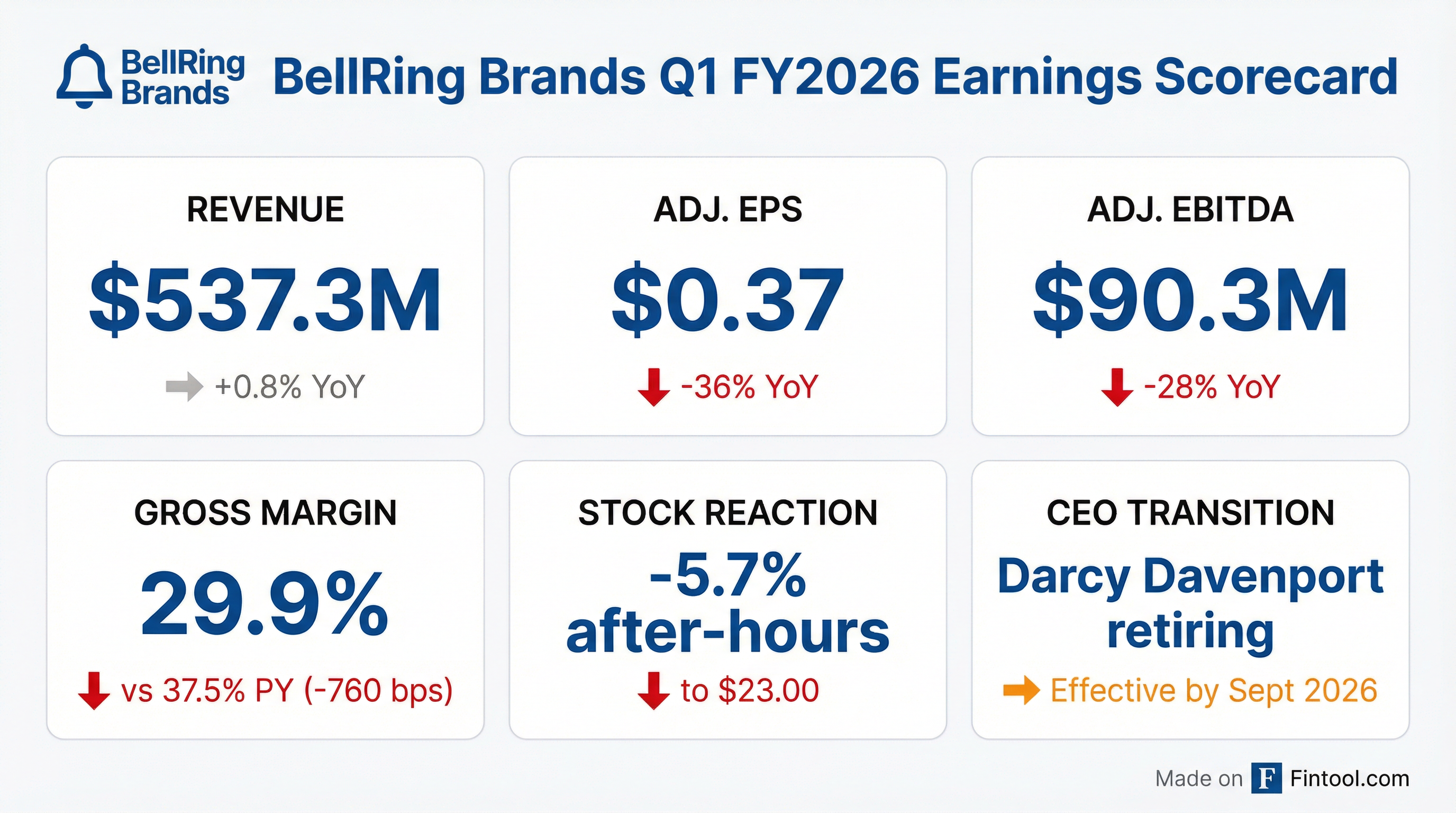
- BellRing Brands (BRBR) reported Q1 2026 net sales of $537 million, a 1% increase year-over-year, with Adjusted EBITDA at $90 million.
- The company narrowed its 2026 net sales guidance to $2.41 billion-$2.46 billion (4%-6% growth) and updated Adjusted EBITDA guidance to $425 million-$440 million.
- Premier Protein net sales decreased 1% in Q1, while Dymatize sales grew 16%.
- The updated guidance incorporates more frequent promotional events from insurgent brands and higher whey costs, leading to an expected 300 basis point decline in Adjusted EBITDA margins for the full year.
- The CEO announced plans to retire by September 30, 2026.
Fintool News
In-depth analysis and coverage of BELLRING BRANDS.


Quarterly earnings call transcripts for BELLRING BRANDS.

Ask Fintool AI Agent
Get instant answers from SEC filings, earnings calls & more